
An alternative to "fund people not projects"
Our catechism for creating impact-maximizing organizations places finding a founder *last*

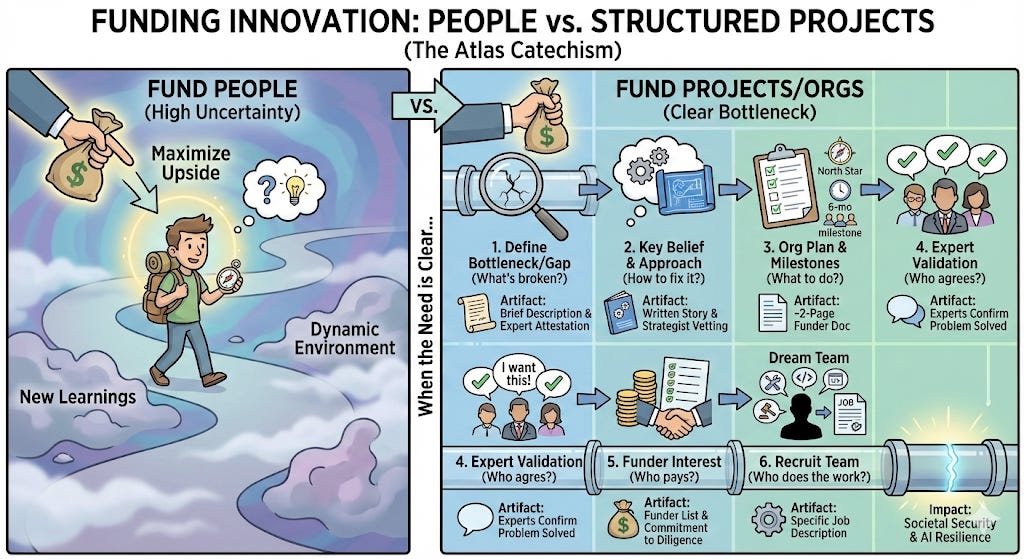
I’m a firm believer that it’s wise to “fund people, not projects” on the margin. I think this is especially true if you are trying to maximize upside in competitive markets with high uncertainty. This holds especially true when your founder or leader has to adapt to new learnings and a highly dynamic environment (for example, in startups or in bleeding-edge research).
However, there are many environments where, from your vantage point, you can see what’s needed, and are confident that someone should just do the thing. Atlas Computing seeks to do this to improve societal security and AI resilience amid growing AI capabilities.
To advance this, we’ve developed the following catechism for starting organizations to unblock predictable technological development bottlenecks and maximize impact. Metascientists and DARPA alums out there will recognize that this was clearly inspired by and aspiring to be an analog of The Heilmeier Catechism for designing impactful research programs.
This complements the AI Resilience Gap Map by outlining a 6-step process to follow for each listed gap (row).
What are you trying to solve? This should be a bottleneck to unblock or a gap to fill.
What’s a good outcome that’s bottlenecked on a breakthrough or effort that no one is working on that would benefit from an intervention?
Note: an intervention could be a new (for- or non-profit) organization, but could also be a contract, advance market commitment, agreement to launch a new product, or bill draft.
Or, what’s a risk that could be mitigated with a targeted intervention, but there’s no one working on that at the moment?
Artifact: Write a brief (<1 page) description about what’s happening today that seems clearly broken and how it should work instead. Get one relevant expert to attest to the real need.
What would you believe (that other reasonable people might disagree with) that would greatly inform how you would approach closing the resilience gap from 1?
Artifact: A written (short) story about how a new org would be sufficient to address the bottleneck (or close the gap).
At least two field strategists should attest that this approach is the most likely to succeed, despite engaged and constructive criticism from the whole cohort of field strategists.
Premised on that belief, what should this intervention do?
Artifact: Write a ~2-page document that could be sent to a funder that describes:
What is their north star mission statement?
Who needs to work with this org, and how does this org solve a pain point for them?
What does their 6-month success milestone to demonstrate competence look like?
How many people are needed to achieve that? How much funding is needed?
What is the longer-term (2-5 year) goal?
What is the legal structure and business model for the org? Who benefits? Who pays?
Who are the most relevant 5-10 experts in the world who can validate (or iterate on) your beliefs from 1-3? These should be advisors, potential users or customers, or organizations that cover this cause area. Actually ask them for feedback.
Artifact: You can move on when they all point to the 2-pager from step 3 and say, “I want this to exist; it would solve a problem for me.”
Once you have buy-in from those users or customers, you have established some preliminary product-market fit. This increases the number of people with the skills to execute on this intervention, since that demand signal will reduce the uncertainty that must be navigated by guiding execution decisions.
Who would be interested in funding this, if presented with the right founding team?
Artifact: a list of funders with a realistic expected value calculation that accounts for the roadmap needed to reach the first milestone
Artifact: at least one of the two biggest funders in the above list expressing interest in the intervention and committing to diligence a team we source to take over and lead execution.
What skills are needed to run this org? Who is likely to have those skills? What experience do they need? Who would be your dream candidate(s)? Who can you think of who’s a plausible candidate, and what gives you pause? You should be confident that the founding team can make all future hiring decisions themselves.
Artifact: Generate a job description with enough specificity that we can give it to a recruiter and find candidates
Feel free to ask questions, comment on specific lines, or download the 1-page PDF of the above doc here.
very related: https://docs.google.com/document/d/1ziUjrt_8rWLmScwNQdprwDuDmNRWHt6tmTZnlAhGRzM/
I think the biggest difference is that I include a step to identify the people who should do the thing, assuming that the author of the plan is not, then, doing the thing. I think this is an important difference, but would not argue with the quality of questions in the above linked doc